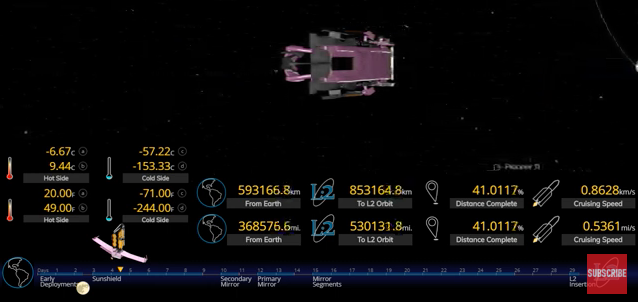
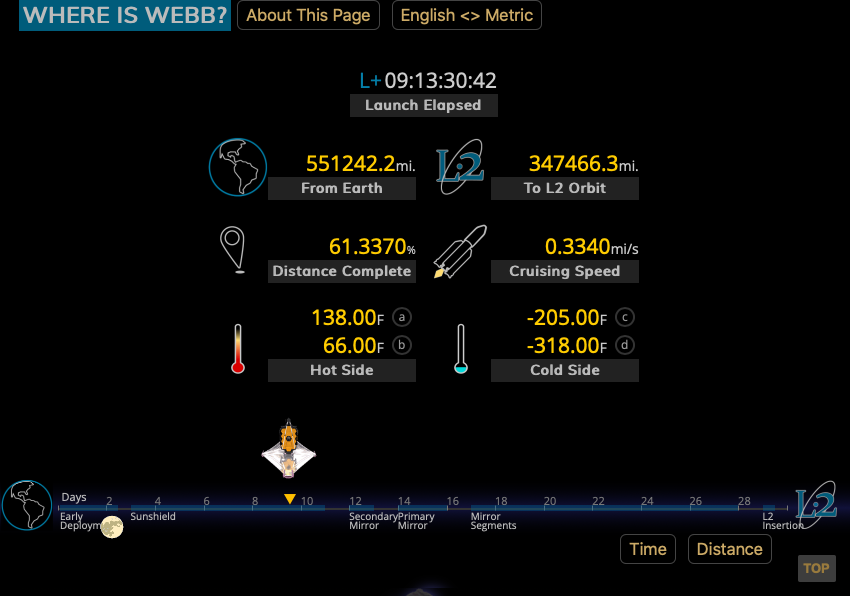

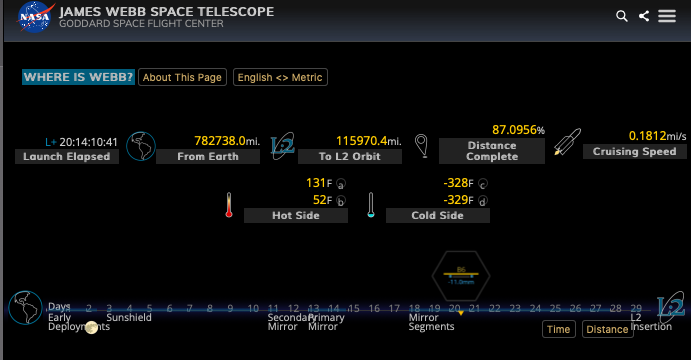

Nasa has successfully launched the James Webb space telescope into orbit, giving scientists the opportunity to peer back further into the universe’s history than ever before.
https://www.youtube.com/watch?v=7nT7JGZMbtM
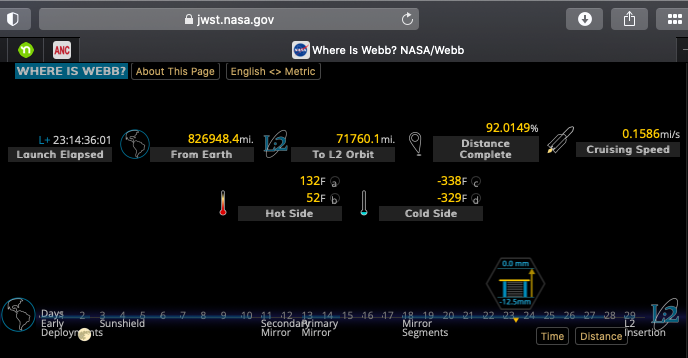
James Webb Telescope, where is it now ?
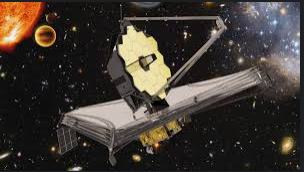
The James Webb Space Telescope is a space telescope developed by NASA with contributions from the European Space Agency and the Canadian Space Agency. It is planned to succeed the Hubble Space Telescope as NASA’s flagship mission in astrophysics. JWST was launched on 25 December 2021 on Ariane flight VA256. Wikipedia
Launch date: December 25, 2021
Dimensions: 20.197 m × 14.162 m (66.26 ft × 46.46 ft), sunshield
Organization: European Space Agency
Operator: Space Telescope Science Institute
Manufacturers: Northrop Grumman, Ball Aerospace & Technologies
It will take about a month for Webb to reach its destination: an orbit around the sun, trailing Earth by 1 million miles, which is about four times the distance between the moon and Earth. Along the way, the telescope must unfold itself — a risky proposition.
After its launch on an Ariane 5 rocket from French Guiana at 1220 GMT, the spacecraft is heading to a gravitationally stable location called a Lagrange point – in this case, the Lagrange point called L2 – that that orbits the sun about 1.5 million kilometres beyond Earth.
The journey to L2 will take about 29 days. Along the way, the Webb will undergo course corrections and critically important deployments of its hardware, including a sun shield the size of a tennis court.
Why is the Webb going to a point so far away? This point in space – the second Lagrangian point – is where, in the Earth-sun system, gravitational forces and a body’s orbital motion balance each other. … For the Webb, another advantage of L2 is that it’s a step farther away from the heat of the sun and Earth.
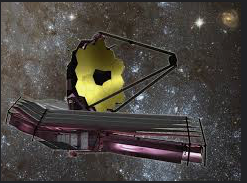
The Webb telescope’s primary mirror is 6.5 meters in diameter, compared with Hubble’s, which is 2.4 meters, giving Webb about seven times as much light-gathering capabilityand thus the ability to see further into the past.
Webb is optimized to view the universe in infrared (IR) light, long wavelengths that we feel as heat. (Hubble, by contrast, views mainly in visible and ultraviolet wavelengths). … “This allows the satellite’s large sunshield to protect the telescope from the light and heat of the sun and Earth (and moon),